Jepara, Central Java — Furniture Manufacturer Since 2011
Prima Furniture - Indonesian teak furniture manufacturer logo CV. Prima Putra · Indonesia
0%

Choosing among Custom Teak Console Tables requires more than comparing photographs and advertised prices. Buyers should examine teak grade, moisture content, joinery, finish quality, and the maker’s production experience. A reliable craftsman should explain whether the wood is plantation-grown, reclaimed, or responsibly sourced. Clear information matters.

Consider the table’s real setting. Measure the hallway, entryway, or living room before requesting a design. Leave enough space for comfortable movement. A console measuring 120 centimeters wide may suit a narrow entrance, while deeper designs can overwhelm smaller rooms. Look closely at drawer alignment, leg stability, edge sanding, and hardware. These details reveal practical workmanship.

Finish samples can show how teak will age under indoor light. Ask about maintenance, delivery protection, and possible color variation. Natural teak may include knots, subtle grain changes, or small tonal differences. That is not necessarily a defect. It can reflect authentic wood character. Still, inconsistent construction deserves careful questioning.

The top choices often combine durable materials, balanced proportions, and thoughtful customization. Yet personal taste remains important. A sculptural base may look impressive but reduce usable storage. A minimalist design may age better, though it can feel too plain for some interiors. There is no perfect table for every buyer.

This guide compares promising options through practical, buyer-focused criteria. It considers craftsmanship, design flexibility, material transparency, durability, and long-term value. Use it as a starting point, not a final verdict. Real samples and direct conversations can reveal what online images hide.
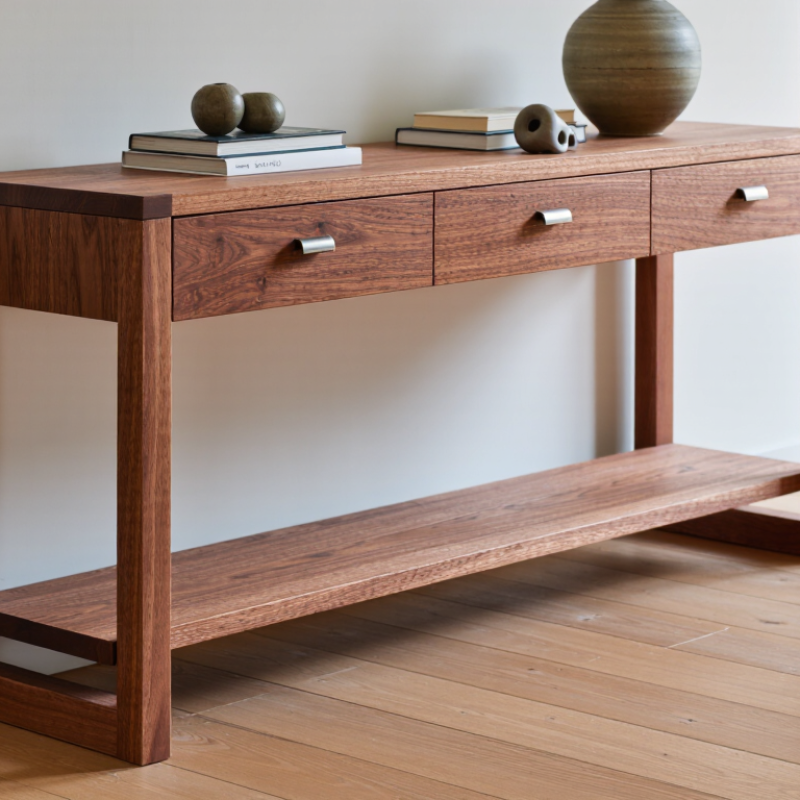
What Are the Top Custom Teak Console Tables for Buyers?

Understanding Custom Teak Console Table Designs

A custom teak console table begins with the room, not a catalog image. Measure the wall, walkway, and nearby door swings before choosing a design. For narrow entryways, a 30–35 centimetre depth usually preserves comfortable movement. Tapered legs create a lighter appearance, while a recessed base gives the piece a floating effect. A lower shelf adds useful storage, but it may collect dust and shoes. Small detail, noticeable impact.

Design choices should match daily habits. A solid slab top suits buyers who prefer natural grain and visual strength. Softened edges make busy hallways safer, especially around children. Drawers can hide keys, chargers, and paperwork without making the table look heavy. Live-edge surfaces provide character, though their irregular outline requires careful wall positioning. Teak’s natural oils resist moisture, yet indoor tables still benefit from a stable, controlled environment. Excessive dryness can cause minor movement over time.

Reliable construction matters more than decoration. Look for accurately joined corners, even leg alignment, smooth sanding, and drawers that close without resistance. Ask how the teak was sourced and whether the finish supports future maintenance. A low-sheen oil can preserve a warm appearance, but it may need periodic renewal. I once preferred a dramatic thick top, then found it crowded a small hallway. The lesson was uncomfortable: beautiful proportions can still be impractical. Custom design works best when appearance, clearance, storage, and long-term care are considered together.

Key Teak Wood Qualities Buyers Should Evaluate

What Are the Top Custom Teak Console Tables for Buyers?

Key Teak Wood Qualities Buyers Should Evaluate

When choosing a custom teak console table, inspect the wood before admiring its shape. Mature teak usually feels dense, stable, and slightly oily to the touch. Dense grain matters.

Look for straight grain, even color, and limited surface cracking. Small knots can add character, but loose knots may weaken narrow legs. Ask for close photographs of joints, undersides, and table edges. These details often reveal rushed construction. A well-made console should use secure mortise-and-tenon joints or carefully fitted joinery. Uneven gaps are warning signs. I once favored a beautiful table with irregular legs, assuming adjustment would be easy. It was not.

Moisture control deserves equal attention. Teak that was poorly dried may warp after entering a heated or air-conditioned room. Ask whether the maker measured moisture before assembly. The answer should be specific, not vague. For indoor use, a smooth, low-sheen finish can protect the surface while preserving the grain. Outdoor placement requires stronger weather planning, including drainage and suitable hardware. Stainless hardware is often a practical choice near damp entrances.

Examine the wood’s origin and documentation when available. Responsible sourcing supports forest protection and gives buyers clearer information. A credible maker should explain the timber grade, finishing process, expected color changes, and care routine. Natural teak may deepen from honey brown to silver-gray over time. That change is normal, though some buyers may dislike it. Sample pieces can help, but they never show every variation.

Comparing Sizes, Shapes, and Storage Configurations

Custom teak console tables work best when their proportions match the room, not only the available wall. A 120–150 cm table suits many entryways, while a 180 cm version anchors a wider living-room wall. Narrow models, around 30–35 cm deep, protect walking space. Rounded or softly curved tops reduce sharp visual edges. Rectangular designs provide stronger display space. I have learned that a beautiful table can still feel awkward when its corners interrupt door movement.

Storage changes the table’s practical value. Open shelves hold baskets, books, or folded throws. Drawers hide keys, chargers, and daily clutter. Sliding doors create a calmer look but need clearance. The 2023 Grand View Research furniture report valued the global furniture market at approximately $516.66 billion in 2022, with continued growth projected through 2030. That scale reflects demand for functional, adaptable furniture, though it does not prove every custom design is worthwhile. Check joinery, drawer movement, wood moisture, and finish consistency. Teak should feel dense and stable, not oily or uneven.

Tips: Measure the wall, walkway, and nearby furniture first. Leave at least 75 cm for comfortable passage. Use painter’s tape to mark the footprint. Compare storage needs honestly. A single drawer may be enough. Or not. Ask for timber origin and care guidance, preferably supported by documented sourcing information. Slight color variation is natural, but major warping deserves careful review.

Assessing Craftsmanship, Customization, and Durability

What Are the Top Custom Teak Console Tables for Buyers?

Craftsmanship begins with the timber, not the finish. Inspect grain direction, joint alignment, and the table’s underside. A well-made console should use dry, stable teak with carefully fitted mortise-and-tenon or dowel joints. The USDA Forest Products Laboratory’s Wood Handbook, FPL-GTR-282, explains that wood moves differently across its grain. Skilled makers allow for that movement. Rigid construction can crack later.

Customization should solve a real room problem. Request exact width, cable openings, drawer depth, or a softened edge. Ask for a written moisture-control plan. Indoor humidity changes can still cause small shifts. That is normal. A perfectly unchanged wooden table is unrealistic. I would also check the finish under strong light. Uneven sheen, open end grain, or sharp corners suggest rushed work.

Durability depends on material history and daily use. Teak naturally contains protective oils, but poor drying can weaken even attractive boards. The FAO Global Forest Resources Assessment 2020 reported 420 million hectares of forest loss since 1990. Its 2022 forest report also identified agriculture as the main driver of global deforestation. Buyers should request traceable sourcing and clear documentation. Reclaimed teak needs extra inspection for old fastener holes and hidden splits. No inspection is perfect. Still, a moisture reading, stable base, replaceable hardware, and repairable finish offer stronger evidence than appearance alone.

What Are the Top Custom Teak Console Tables for Buyers? — Assessing Craftsmanship, Customization, and Durability

Custom Table Type Typical Dimensions Craftsmanship Features Customization Potential Expected Durability Maintenance Needs Best Use Buyer Assessment
Solid Teak Slab Console 120–180 cm W × 30–45 cm D × 75–85 cm H One-piece or book-matched top, visible natural grain, mortise-and-tenon or reinforced joinery, hand-sanded edges High: length, depth, edge profile, leg style, cable openings, and finish can usually be specified ★★★★★
Excellent for indoor use when properly kiln-dried and sealed
Dust regularly; wipe spills promptly; re-oil only when the surface appears dry if an oil finish is used Entryways, living rooms, and statement interiors Best overall choice for buyers prioritizing solid construction, natural character, and long service life
Minimalist Teak Console with Tapered Legs 100–160 cm W × 28–40 cm D × 75–82 cm H Thin-profile top, accurately aligned tapered legs, concealed fasteners, smooth transition between top and frame High: leg angle, overall height, top thickness, and wood tone can be adjusted ★★★★☆
Very good indoors; thinner components require careful handling
Use coasters and avoid prolonged moisture; clean with a soft, slightly damp cloth Hallways, apartments, and contemporary spaces Strong option where a lighter visual footprint and precise proportions matter
Teak Console with Drawers 120–180 cm W × 35–45 cm D × 75–85 cm H Graduated drawer gaps, durable runners, reinforced drawer boxes, consistent alignment, and sealed interior surfaces Medium to high: drawer count, hardware style, compartment layout, and dimensions are commonly configurable ★★★★☆
Very good when drawer hardware and case joints are well engineered
Keep drawer interiors dry; avoid overloading; check hardware alignment periodically Dining rooms, home offices, and storage-focused entryways Best for buyers who need concealed storage without sacrificing a warm wood appearance
Teak and Metal Frame Console 110–180 cm W × 30–40 cm D × 75–85 cm H Solid teak top paired with welded or mechanically joined metal supports; adjustable feet improve stability on uneven floors High: metal finish, frame geometry, top thickness, and dimensions can be selected ★★★★☆
Very good indoors; outdoor suitability depends on corrosion-resistant metal and exterior-grade finishing
Clean teak and metal separately; protect untreated steel from moisture and condensation Industrial, modern, and commercial interiors Suitable for buyers seeking strong visual contrast and a structurally open design
Live-Edge Teak Console 120–200 cm W × 35–55 cm D × 75–85 cm H Natural edge retained, stabilized slab, filled checks where necessary, flattened top, and carefully supported base Medium: slab shape is naturally unique, while length, support style, and surface sheen can be selected ★★★★☆
Very good when moisture content is controlled and the slab is properly supported
Keep away from direct heat; maintain stable indoor humidity; inspect natural checks over time Feature walls, lounges, and hospitality interiors Best for buyers who value individuality and visible natural variation over uniformity
Outdoor-Rated Teak Console 100–180 cm W × 35–50 cm D × 75–90 cm H Exterior-grade joinery, drainage-conscious construction, rounded water-shedding edges, and weather-appropriate fasteners Medium to high: dimensions, shelf configuration, edge treatment, and surface finish can often be specified ★★★★★
Excellent outdoors because teak contains naturally durable oils; weather exposure still affects appearance
Allow airflow, avoid standing water, clean periodically, and use a teak sealer only when a consistent color is desired Covered patios, porches, poolside areas, and sheltered outdoor entrances Top choice for outdoor buyers, provided the design includes drainage and suitable hardware
Reclaimed Teak Console 100–180 cm W × 30–45 cm D × 75–85 cm H Repaired nail holes, stabilized boards, mixed grain patterns, visible patina, and individually assessed structural condition Medium: dimensions and finish can be customized, but existing marks and board character remain part of the design ★★★☆☆
Durability varies according to the wood’s previous use and restoration quality
Use gentle cleaning products; avoid aggressive sanding that could remove patina or weaken repaired areas Rustic, coastal, and sustainability-focused interiors Good for buyers who prioritize character and material reuse, provided the structure is thoroughly inspected

Buying note: Actual performance depends on teak moisture content, board quality, joinery, finish, load distribution, indoor humidity, and exposure to weather. Confirm the final dimensions, wood grade, finish system, hardware, care instructions, and warranty terms before ordering a custom piece.

Choosing the Right Custom Teak Console Table for Your Space

Choosing the Right Custom Teak Console Table for Your Space

A custom teak console table should fit your room before it impresses your guests. Measure the wall, walkway, and nearby furniture carefully. Leave at least 30 inches for comfortable passage. In a narrow entryway, choose a slim rectangular design with softened corners. A floating console can create more floor space. It also makes cleaning easier.

Think about daily use, not only appearance. Drawers can hold keys, mail, and small electronics. Open shelving suits baskets and display pieces. If you need visual warmth, consider a live-edge top with restrained metal or wooden legs. Slatted fronts add texture without making the table feel heavy. Teak naturally handles humidity well, but indoor furniture still needs sensible protection from spills and strong sunlight.

Ask the maker about timber grade, board thickness, joinery, and finish maintenance. A well-made table should feel stable when you press lightly against its edge. Check whether the surface is sealed, oiled, or left with a more natural finish. Each choice changes color, touch, and upkeep. The first design is rarely perfect. I would rather revise a rough sketch than receive a beautiful table that blocks a doorway. Small details matter, including cable openings, adjustable feet, and the exact height of your sofa or console mirror.

FAQS

What teak qualities should buyers inspect first?

Look for dense wood, straight grain, even color, and limited surface cracking. Small knots are acceptable. Loose knots may weaken narrow legs.

How can buyers evaluate a console table’s construction?

Request close photos of joints, edges, and the underside. Mortise-and-tenon or fitted dowel joints usually show careful work. Uneven gaps suggest rushed assembly.

Why does moisture control matter for teak furniture?

Poorly dried teak may warp in heated or air-conditioned rooms. Ask for a specific moisture measurement before assembly. Vague answers deserve caution.

Which console table dimensions suit an entryway?

A width of 120–150 centimeters suits many entryways. Keep the depth near 30–35 centimeters. Leave at least 75 centimeters for walking space.

How should buyers choose storage features?

Open shelves display baskets and books. Drawers hide keys, chargers, and small clutter. Sliding doors look calmer but require extra clearance.

What customization options are genuinely useful?

Consider exact width, cable openings, drawer depth, and softened edges. Customization should solve a room problem. More features are not always better.

How does teak’s color change over time?

Natural teak may shift from honey brown to silver-gray. This change is normal. Samples help, but they cannot show every grain variation.

What finish and hardware should buyers consider?

Indoor tables often suit a smooth, low-sheen finish. Outdoor or damp areas need drainage planning and corrosion-resistant hardware. Stainless hardware is practical near wet entrances.

How can buyers assess responsible sourcing?

Ask for timber origin, grade, and supporting documentation. Reclaimed wood needs inspection for old fastener holes and hidden splits. Records are useful, but not perfect.

What warning signs should buyers not ignore?

Watch for major warping, irregular legs, open end grain, sharp corners, and uneven sheen. I once assumed an awkward leg could be adjusted easily. It could not.

Conclusion

Custom Teak Console Tables offer a practical and elegant way to enhance entryways, living rooms, hallways, and other interior spaces. This guide explores popular design options, including minimalist profiles, sculptural bases, floating styles, and models with drawers or open shelving. Buyers will also learn how to evaluate teak wood quality by considering grain character, moisture resistance, stability, color, and responsible material selection.

The article compares different lengths, depths, shapes, and storage configurations to help match a table with available space and daily needs. It also explains how craftsmanship, joinery, surface finishing, hardware, and customization affect durability and appearance. By considering the room’s layout, décor, maintenance expectations, and desired function, readers can confidently choose a custom teak console table that balances beauty, performance, storage, and long-term value.


Elara

Elara

Elara is a professional marketing specialist dedicated to helping businesses better understand the value, quality, and practical applications of our company’s products. With a strong background in market research, customer communication, content strategy, and product education, Elara combines......
Talk