Choosing a China top solid teak sun loungers wholesale manufacturer requires more than comparing prices. It requires material knowledge, production evidence, and careful questions. Solid Teak Sun Loungers should feel substantial, not merely look warm in product photographs. A reliable manufacturer can explain teak grading, moisture control, joint construction, sanding standards, and outdoor finishing methods. Ask for factory images, sample pieces, inspection records, and clear packaging details. Small details matter. Smooth armrests matter.
William Morris, a respected furniture and design authority, wrote, “Have nothing in your house that you do not know to be useful, or believe to be beautiful.” His principle remains useful here. A commercial lounger must support the body comfortably, stack or fold as promised, and survive changing weather. Beauty alone cannot solve loose screws, uneven slats, or poorly sealed end grain.
This guide examines how wholesale buyers can assess Chinese manufacturers with greater confidence. It considers teak origin documentation, responsible sourcing claims, kiln-dried wood, stainless-steel hardware, ergonomic testing, and quality-control procedures. It also explores customization, container loading, lead times, and after-sales support. A trustworthy supplier should welcome practical questions instead of hiding behind polished catalogs.
There is no perfect lounger. Wood can develop small color variations, and outdoor teak still needs sensible care. That is not a failure. The real concern is inconsistent grading or unclear promises. Buyers should compare physical samples against written specifications. They should also verify certifications independently when responsible sourcing is important. With disciplined evaluation, a China manufacturer can provide durable Solid Teak Sun Loungers for resorts, garden retailers, hospitality projects, and private outdoor spaces.
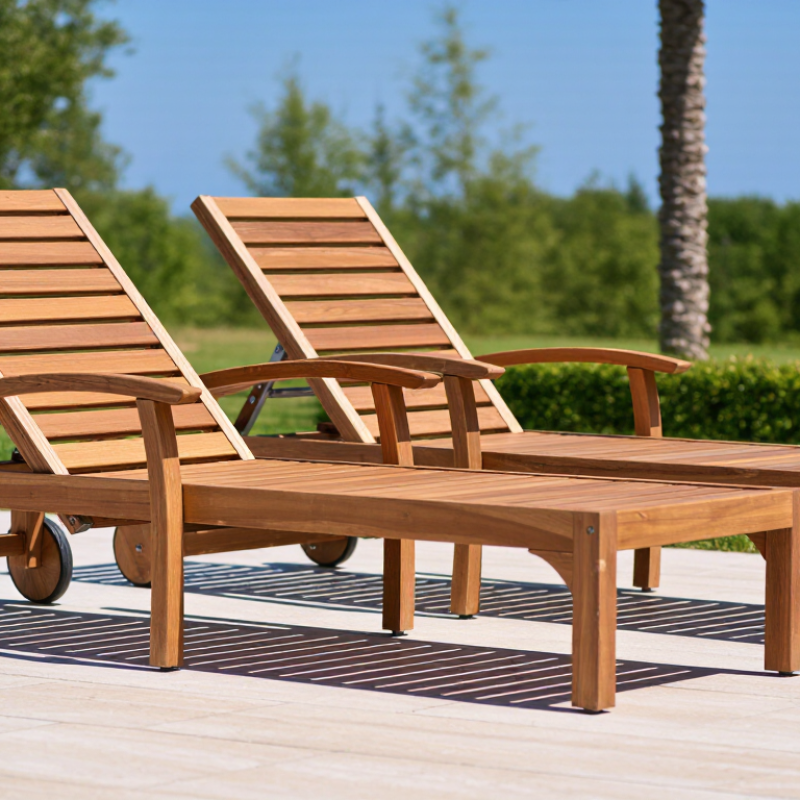
A high-quality solid teak sun lounger begins with honest material selection. Grade-A heartwood has tight grain, warm color, and fewer visible knots. The USDA Forest Products Laboratory explains that moisture changes cause wood movement and surface checking. Therefore, kiln-dried teak needs stable moisture control before assembly. A cheap, rushed process often creates loose joints later.
Teak is dense, but density alone proves little. The Wood Database records teak at about 1,070 lbf on the Janka hardness scale. That supports strong resistance to daily impacts and wear. Look closely at the frame corners. Proper mortise-and-tenon joints, stainless steel fasteners, and smooth sanding matter more than a glossy finish. No finish lasts forever. Water should drain from the seat instead of pooling around screws.
For wholesale buyers, test several samples rather than trusting one attractive piece. Open and close the backrest repeatedly. Check whether the hinges move quietly and evenly. Measure the slat gaps, because uneven spacing can trap water and dirt. The Forest Stewardship Council reported more than 160 million hectares of certified forests in 2023, making traceable sourcing easier to verify.
Still, certification does not guarantee craftsmanship. I would request moisture records, timber-origin documents, load-test results, and photographs from production. One weakness remains easy to miss: a lounger may look excellent indoors but warp after months outdoors. A realistic inspection should include that possibility.
China Top Solid Teak Sun Loungers Wholesale Manufacturer?
How Chinese Manufacturers Produce Teak Sun Loungers
Chinese manufacturers usually begin with solid teak selection and moisture testing. Experienced workshops inspect grain direction, knots, cracks, and color variation before cutting. Properly kiln-dried teak reduces twisting during storage and outdoor use. However, natural wood is never perfectly uniform. Buyers should accept small differences in tone and texture.
Production teams cut frames with CNC equipment or skilled woodworking tools. They shape reclining parts, drill connection points, and smooth every exposed edge. Stainless steel hardware often supports the adjustable backrest. Workers then dry-fit each frame before final assembly. This step reveals loose joints, uneven gaps, or weak movement. Sanding usually progresses from coarse paper to a finer finish. Some factories apply outdoor oil, while others ship the wood untreated. Both choices require clear care instructions.
Tips: Request a moisture report, wood specification, and sample before placing a large order. Check the recline mechanism several times. Ask for frame load testing and carton-drop testing. Inspect the underside, not only the visible surfaces. That is where rushed workmanship often appears.
Reliable suppliers record measurements, hardware types, fabric details, and inspection results for each batch. They should also explain packaging thickness and replacement procedures for damaged components. A sample may look excellent, yet mass production can expose inconsistencies. Independent inspection remains useful when order value is high. This is less convenient, but it protects expectations.
| Production Stage | Typical Material or Specification | How the Process Is Carried Out | Quality-Control Focus | Wholesale Considerations |
|---|---|---|---|---|
| 1. Teak Timber Selection | Solid teak, commonly identified as Tectona grandis, selected for outdoor furniture components. | Boards are sorted according to thickness, grain direction, color, knots, splits, and visible defects before cutting. | Confirm that the frame and load-bearing parts are made from solid teak rather than teak veneer or teak-look materials. | Buyers should request written material specifications and agree on acceptable natural color variation before production. |
| 2. Timber Drying and Conditioning | Furniture-grade timber is commonly conditioned to an approximate moisture range of 8%–14%, depending on climate and end market. | Kiln drying or controlled air drying reduces excess moisture, followed by storage in a stable workshop environment. | Moisture meters are used to reduce the risk of later shrinkage, swelling, joint movement, and surface cracking. | The target moisture level should match the destination climate, especially for shipments to dry, cold, or highly humid regions. |
| 3. Component Cutting | Common parts include side rails, back legs, front legs, armrests, backrest slats, seat slats, and support bars. | Computer-controlled or precision saws cut components to approved drawings and cutting lists. | Inspect dimensions, end-grain condition, grain orientation, and the absence of major cracks in structural parts. | Standardized cutting lists help control replacement parts, carton sizes, and repeat-order consistency. |
| 4. Joint Machining | Outdoor furniture may use mortise-and-tenon, dowel, screw, or combined mechanical joints. | Machined joints are formed with drilling, routing, and milling equipment, then test-fitted before final assembly. | Check joint tightness, alignment, glue coverage where applicable, and the use of corrosion-resistant fasteners. | Ask for the joint construction method, fastener material, and repair or replacement procedure for commercial orders. |
| 5. Profile Shaping and Edge Rounding | Rounded edges and shaped armrests improve handling comfort and reduce sharp exposed corners. | Routers, sanders, and profiling tools shape the frame before final surface preparation. | Edges should be uniform, smooth, and free from cutter burns, deep tool marks, and abrupt transitions. | Approved samples or technical drawings are useful for controlling the appearance across multiple production batches. |
| 6. Sanding | Surface preparation typically progresses from coarse sanding to finer sanding suitable for outdoor furniture finishing. | Machine sanding is combined with hand sanding around joints, corners, slats, and curved sections. | Inspect for scratches, raised grain, uneven transitions, glue marks, and rough contact surfaces. | Uniform sanding improves finish consistency and reduces customer complaints about splinters or rough touch points. |
| 7. Trial Assembly | Each lounger is checked as a complete unit before finishing or final packing. | Parts are assembled temporarily to verify frame geometry, backrest movement, leg stability, and hardware fit. | The lounger should sit level, open and close smoothly, and remain stable on a flat surface. | Pre-finish inspection allows dimensional corrections without damaging the final coating or oil treatment. |
| 8. Outdoor Finish Application | Options include an unfinished natural teak surface, penetrating teak oil, or a specified outdoor wood coating. | Surfaces are cleaned and dry before the selected finish is applied by wiping, brushing, or controlled spraying. | Check coverage, color uniformity, drying time, adhesion, and the absence of runs, bubbles, or contaminated areas. | Unfinished teak naturally weathers toward silver-gray outdoors; an oil or coating schedule should be clearly communicated. |
| 9. Hardware and Function Testing | Common hardware includes stainless steel or other corrosion-resistant screws, pins, hinges, and adjustment components. | Hardware is installed after finishing where practical, and moving sections are tested repeatedly. | Verify that hinges do not bind, locking positions hold securely, and fasteners are fully seated without damaging the wood. | For coastal or poolside projects, specify a suitable corrosion-resistance requirement and maintenance plan. |
| 10. Load and Stability Inspection | Performance depends on frame design, slat thickness, joint construction, hardware, and the intended user load. | Factories may conduct visual, dimensional, stability, and load checks according to the buyer’s agreed inspection plan. | Look for rocking, excessive deflection, joint opening, loose slats, and instability when the backrest is adjusted. | Wholesale buyers should define test methods and acceptance criteria before mass production rather than relying only on visual checks. |
| 11. Final Inspection | Inspection normally covers appearance, dimensions, function, hardware, finish, labeling, and packaging. | Quality staff compare finished products with approved samples, drawings, and purchase-order requirements. | Record defects by category and verify corrective actions before shipment. | Pre-shipment inspection can include sampling based on an agreed acceptance-quality limit and defect classification. |
| 12. Packaging and Export Preparation | Typical protection includes recyclable cartons, corner protection, foam or paper padding, moisture protection, and palletization where required. | Loungers are folded or partially disassembled when the design permits, then packed to reduce damage and shipping volume. | Check carton strength, internal movement, hardware bags, assembly instructions, and carton markings. | Packaging design affects freight cost, container utilization, warehouse handling, and the rate of transit damage. |
| 13. Wholesale Specification Checklist | Key requirements include timber type, dimensions, finish, hardware, adjustment positions, cushion options, packaging, and quantity. | Requirements are documented in drawings, approved samples, product specifications, and inspection procedures. | Every critical requirement should be measurable or visually verifiable before shipment. | A clear specification reduces differences between samples, production goods, and repeat wholesale orders. |
Wholesale teak sun lounger collections should balance outdoor comfort, production consistency, and practical shipping needs. Experienced buyers usually inspect teak density, moisture control, and joint construction. Properly kiln-dried teak reduces unnecessary movement after installation. Smoothly sanded surfaces prevent rough contact against bare legs. Strong mortise-and-tenon joints also support frequent commercial use.
Adjustable backrests should move steadily and hold several comfortable positions. Stainless steel hardware helps resist rust in humid coastal settings. Wide wheels make relocation easier across stone, decking, or poolside paving. Stackable frames can reduce warehouse space, but stacking height must remain stable. Some collections include removable cushions with quick-drying foam and washable covers. These details affect cleaning time and guest satisfaction. However, no teak lounger is maintenance-free. Natural color changes are normal, and small surface checks may appear over time.
Tips: Request a sample before placing a large order. Test the backrest, wheel movement, and frame balance in person. Check dimensions against containers, storage rooms, and hospitality layouts. Ask for wood-origin documents, moisture specifications, load testing, and hardware details. A reliable manufacturer should explain production tolerances clearly, not promise identical natural grain. We once underestimated cushion drying time in a humid project; that mistake changed our material checklist. Small practical checks often prevent expensive replacements.
China Top Solid Teak Sun Loungers Wholesale Manufacturer?
Evaluating a reliable Chinese wholesale manufacturer requires more than comparing prices. Inspect the factory’s production records, material sources, and quality procedures. Solid teak should have clear origin documentation and consistent moisture control. Ask whether timber is kiln-dried, because unstable wood may crack after shipment. Request close photographs of joints, wheels, hinges, and underside treatment. These details often reveal construction quality.
Order a sample before placing a larger purchase. Test its reclining mechanism repeatedly. Check whether the frame feels balanced on a hard floor. Measure the lounger against the approved drawing, including length, width, and cushion clearance. A dependable supplier should provide a written specification, inspection standard, packaging plan, and replacement policy. Independent pre-shipment inspection can verify quantities, surface defects, hardware, and carton strength. Do not rely only on factory photographs.
Communication also shows professional maturity. The manufacturer should answer technical questions directly and report production delays early. Ask for relevant export experience, product test records, and traceable quality-control documents. Be careful with unusually low quotations. They may indicate thinner timber, untreated surfaces, or weaker fittings. A polished showroom can mislead. One practical weakness is that some buyers approve samples but ignore mass-production monitoring. That gap creates avoidable disputes. Keep signed drawings, material requirements, inspection photos, and packaging approvals in one shared file. Even experienced purchasers miss small details, especially when design changes happen by message. Recheck every revision before production begins.
This suggested evaluation framework assigns the greatest weight to product quality and material authenticity, followed by production capability, export compliance, quality control, communication, and after-sales support. Buyers should verify each item with samples, inspection records, documentation, and written commercial terms before placing a wholesale order.
Buying solid teak sun loungers wholesale requires more than comparing catalog prices. Grand View Research estimates the global outdoor furniture market at over USD 20 billion, with continued growth through 2030. This demand attracts capable factories and careless suppliers. Request timber origin records, moisture readings, production photos, and a detailed purchase contract. Confirm dimensions, cushion specifications, finish, packing method, and acceptable defect limits before paying a deposit.
Quality control should happen at several stages. Inspect the timber before cutting. Teak should show consistent grain, stable joints, and no excessive cracking. A digital moisture meter helps, but readings can vary across boards. That is an imperfect safeguard. The American Society for Testing and Materials publishes relevant standards for wood moisture measurement and furniture performance, which can guide inspection procedures. Use a pre-shipment checklist covering frame alignment, screw tightness, sanding, coating uniformity, folding hardware, and load testing. Keep dated photographs and random inspection records.
Export planning often decides the real cost. The World Bank’s Logistics Performance Index highlights customs efficiency, shipment tracking, and infrastructure as major logistics factors. Ask the supplier for the correct HS classification, commercial invoice, packing list, and legally required timber documentation. Wooden export packaging may require ISPM 15 treatment and marking. Check destination rules before production, especially where due-diligence requirements apply. Container loading also matters. Unprotected corners can bruise during handling, while excessive wrapping increases waste and disposal costs. A trial order is wiser than a large commitment. Mistakes become expensive at sea.
Workers inspect grain direction, knots, cracks, and color variation before cutting. They also test moisture levels. Natural variation remains. Small differences in tone and texture are normal.
Kiln drying reduces twisting during storage and outdoor use. It helps frames keep their shape after installation. However, wood can still move slightly with changing weather.
Factories cut frame parts using CNC equipment or skilled woodworking tools. Workers shape reclining sections and drill connection points. They then smooth every exposed edge. Some details may vary between production batches.
Workers dry-fit each frame before final assembly. They check loose joints, uneven gaps, and weak movement. The backrest should hold several comfortable positions. Test it repeatedly.
Stainless steel hardware often supports the adjustable backrest. It provides better rust resistance in humid coastal areas. Buyers should confirm the hardware type before ordering.
Request a sample, moisture report, wood specification, and load-testing records. Check the underside, not only visible surfaces. Inspect joints, wheels, gaps, and frame balance. Rushed workmanship often hides underneath.
Ask about carton thickness, drop testing, and damaged-component replacement procedures. Check whether packaging protects corners, wheels, cushions, and reclining parts. A strong sample does not guarantee perfect mass production. Independent inspection can reduce unpleasant surprises.
No. Natural teak changes color over time. Small surface checks may also appear. Some factories apply outdoor oil, while others ship untreated wood. Both options require clear care instructions.
Wide wheels help movement across paving, decking, and poolside surfaces. Stackable frames can save warehouse space. Stable stacking height still needs checking. Removable cushions with quick-drying foam may reduce cleaning delays. We once underestimated cushion drying time in humid conditions.
This article explains what distinguishes high-quality Solid Teak Sun Loungers, focusing on responsibly selected teak, strong construction, smooth finishing, comfortable proportions, and dependable resistance to outdoor conditions. It also outlines how Chinese manufacturers transform teak into durable loungers through moisture control, precision cutting, careful assembly, sanding, and protective finishing. Wholesale collections may include adjustable backrests, ergonomic designs, removable cushions, wheels, folding structures, and coordinated outdoor furniture options to meet different market requirements.
The guide also provides practical advice for evaluating a reliable Chinese wholesale manufacturer, including reviewing production capabilities, material standards, sample quality, customization services, communication, and inspection procedures. It highlights important considerations for ordering and exporting, such as confirming specifications, packaging, lead times, quality control checkpoints, documentation, and shipment arrangements. By following these steps, buyers can reduce purchasing risks and establish a consistent supply of well-made teak loungers for hospitality, retail, and outdoor living projects.