Choosing the right Teak Garden Benches involves more than admiring their warm, golden colour. A strong bench must handle sunlight, rain, temperature changes, and daily use. It should also feel comfortable beside a flower bed, patio table, or quiet garden path.
Wood scientist R. Bruce Hoadley wrote, “Wood is a natural material, and as such, it is subject to change.” This observation matters when comparing teak furniture. Even high-quality teak gradually develops a silver-grey surface outdoors. That change is not necessarily damage. It reflects weathering, maintenance choices, and the wood’s natural character.
Look closely at the timber grade, grain, joinery, and hardware. Premium teak usually has a dense, even texture with fewer large knots. Mortise-and-tenon joints often provide better stability than thin fasteners alone. Stainless-steel hardware can reduce rust stains around the legs and armrests. Small details matter.
Do not ignore comfort.
A well-built bench may still feel unpleasant if its seat is too deep, its back angle is rigid, or its edges are sharp. Sit on the bench before purchasing whenever possible. Check whether water can drain easily after a storm. Examine the underside, too. Weak supports often hide there.
Certified timber can offer stronger sourcing information, although certification should not replace careful product inspection. Maintenance advice also deserves attention. Some owners prefer natural silvering, while others regularly apply teak oil. Neither choice is completely effortless. Even the best bench needs sensible placement, occasional cleaning, and realistic expectations about outdoor wear.
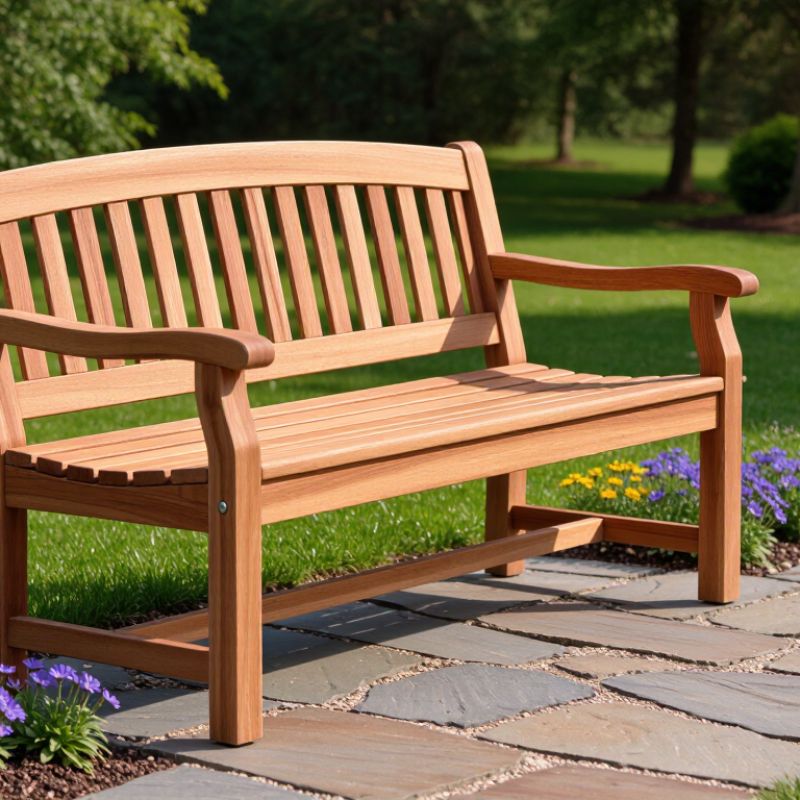
When choosing a teak garden bench, inspect the wood grade before judging its design. The USDA Forest Products Laboratory’s Wood Handbook (2021) explains that wood density changes with moisture content and measurement method. For outdoor teak, 650–750 kg/m³ at approximately 12% moisture is a useful buying reference. It is not an absolute quality guarantee.
Ask the supplier for the test method, moisture basis, and timber source. A bench within this range should feel substantial, resist dents, and show consistent grain across the seat. I would still inspect the joints. Dense wood cannot repair poor construction. Tap the boards, check for open cracks, and look beneath the seat for trapped water paths. Small mistakes matter outdoors.
FSC certification adds a separate layer of confidence. The FSC Chain of Custody Standard, FSC-STD-40-004, requires certified material to remain traceable through relevant supply stages. Request the certificate code and verify its scope through the FSC public database. Do not accept “FSC wood” as enough evidence. The certificate may cover a product group, not every component. Also, FSC status does not automatically confirm 650–750 kg/m³ density. These are different checks. A careful buyer should compare both documents, although paperwork can still contain gaps. Real-world inspection remains necessary.
| Assessment Dimension | What to Check | Preferred Buying Signal | Important Note |
|---|---|---|---|
| Wood density | Ask for the stated density and the measurement basis, such as air-dry wood at approximately 12% moisture content. | About 650–750 kg/m³ is a useful indicative range for evaluating teak at typical air-dry conditions. | Density varies with moisture content, growing conditions, and the piece of wood. A number alone does not prove species or quality. |
| FSC certification | Check that the product claim is supported by valid FSC documentation and that the certificate scope covers the relevant product or supply chain. | Clear, verifiable evidence of responsible sourcing and chain-of-custody coverage. | FSC certification relates to forest sourcing and supply-chain claims; it is not a grading system for wood density, appearance, or durability. |
| Grade description | Request a written definition of terms such as “Grade A,” “premium,” or “select,” including the seller’s criteria. | Transparent, measurable criteria for color variation, knots, checks, sapwood, and visible defects. | Teak grade labels are not universally standardized. Compare the stated criteria rather than relying on the grade name alone. |
| Heartwood and sapwood | Inspect visible surfaces and ask whether the bench includes sapwood. | Consistent heartwood across the main exposed components, with any sapwood clearly disclosed. | Heartwood is generally more naturally durable than sapwood. Appearance and color can vary even within heartwood. |
| Moisture and construction | Ask whether the timber was seasoned and inspect joints, fasteners, and the underside of the seat. | Stable construction, tight joints, smooth edges, and corrosion-resistant outdoor hardware. | Wood naturally responds to changes in moisture and temperature. Small surface checks or color changes may occur outdoors. |
| Outdoor maintenance | Confirm the care instructions and whether the bench is intended to weather naturally. | Instructions explain cleaning, optional oiling, and protection during prolonged exposure to harsh conditions. | Unfinished teak typically weathers toward a silvery-gray surface; this color change is cosmetic and does not by itself indicate failure. |
Many last 20–30 years outdoors with sensible care. Climate and workmanship still matter. I would not promise exactly thirty years.
Look for warm golden-brown heartwood, tight grain, and few soft knots. Lighter sapwood is usually less durable. Weight helps, but proves little.
Place it on stone or concrete rather than wet soil. Leave air beneath the seat. Remove leaves from joints after rain.
Choose 316 stainless-steel bolts, screws, washers, and inserts. This hardware better resists salt air and damp conditions. Small parts matter.
Look for close-fitting mortise-and-tenon joints with full shoulder contact. Push the frame gently. Any wobble deserves attention.
Check beneath the seat and around every corner. Look for cracks, water pockets, and tiny gaps. A glossy finish can hide weak construction.
Clean it twice yearly, around spring and early autumn. Use mild soap, water, and a soft brush. Scrub along the grain.
Oil mainly preserves a warmer color, not durability. Untreated teak gradually becomes silver gray. Applying oil to damp wood may create cloudy patches. I learned that the hard way.
Choosing the best Teak Garden Benches starts with evaluating the wood itself. Look for responsibly sourced teak with FSC certification, a sign of controlled forestry practices, and a density around 650–750 kg/m³ for strength and stability. Comfort is equally important, so consider a seat height of approximately 45–50 cm and a depth of 40–50 cm to support relaxed sitting. Since quality teak benches can typically remain outdoors for 20–30 years, selecting durable materials and sound design is a worthwhile investment.
Construction details also affect long-term performance. 316 stainless steel hardware offers strong resistance to outdoor moisture and corrosion, while mortise-and-tenon joints can provide a secure, stable frame when properly made. Maintenance is simple: clean the bench about twice a year to remove dirt and surface buildup. Teak oil is optional and should be used mainly when you want to preserve a richer original color; it is not essential for protecting the wood’s natural durability.