Choosing the right Custom Wooden Bar Stools involves more than matching wood tones to a kitchen island. Height, comfort, joinery, balance, and daily durability all matter. A beautiful stool can still feel awkward after ten minutes. That detail is easy to miss.
Thomas Moser, the respected American furniture maker, offers a useful principle: “A chair must be comfortable before it can be beautiful.” His view applies directly to bar seating. The best stools support the lower back, provide enough foot space, and remain steady when someone shifts position. Solid maple, oak, walnut, and ash each create different textures and strength levels. Traditional mortise-and-tenon joints usually offer dependable durability, while carefully sealed finishes help protect against spilled drinks and kitchen humidity.
This guide examines what separates excellent Custom Wooden Bar Stools from attractive but disappointing options. We will consider seat height, wood selection, craftsmanship, upholstery, footrests, and customization possibilities. A counter stool usually needs a different height than a bar stool. That mistake happens often.
Personal experience also matters. A stool may look perfect in a product photograph, yet feel hard, narrow, or unstable at home. Measuring your counter twice is wiser than trusting a quick estimate. Still, no single design suits every room or body type. Some recommendations may need reconsideration after real use, especially when style competes with comfort. The goal is not to find the most expensive stool. It is to find a well-made seat that feels natural, stays stable, and earns its place around the counter.
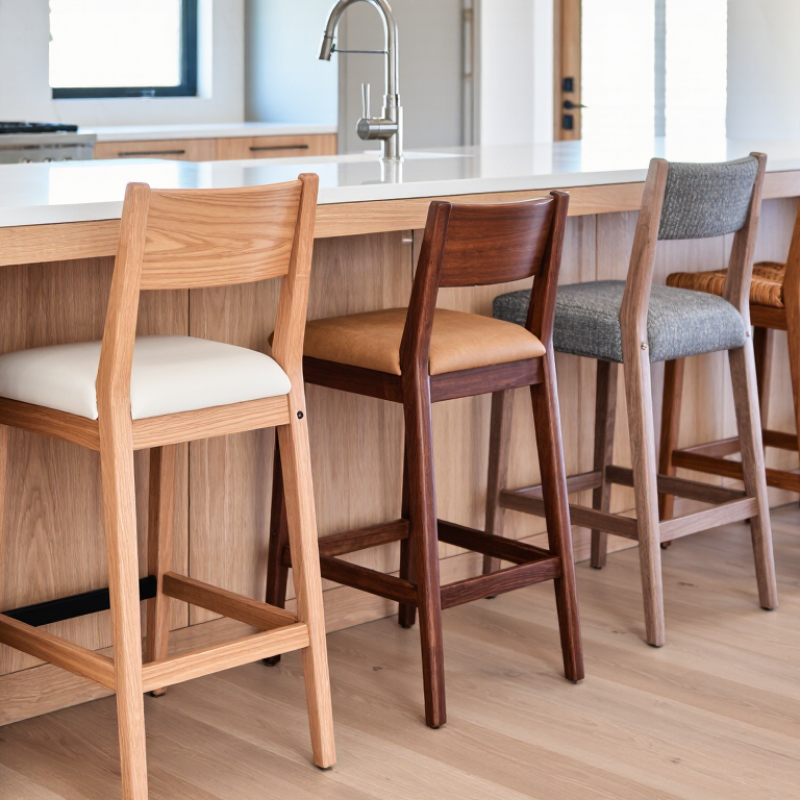
Define Bar-Stool Heights: Counter 24–26 in; Bar 28–30 in
What Are the Best Custom Wooden Bar Stools?
The best custom wooden bar stool begins with the surface height, not the wood species. NKBA Kitchen Planning Guidelines place counter seating at 24–26 inches from floor to seat. Bar seating usually needs 28–30 inches. These measurements leave roughly 9–13 inches between the seat and countertop, allowing knees to move without hitting the edge.
Measure carefully. Twice.
A custom maker should confirm the finished seat height after sanding, upholstery, and floor protectors. A 25-inch counter stool can feel wrong beside a thick 2-inch countertop.
For a 36-inch counter, a 24–26-inch seat is generally comfortable.
For a 42-inch bar, choose 28–30 inches.
The National Kitchen and Bath Association also emphasizes clearances around seating zones, while ADA Standards recommend accessible dining surfaces between 28 and 34 inches high. That guidance may require one lower, approach-friendly position in mixed-use spaces.
Wood adds warmth, but it can also expose mistakes. I have found that a footrest becomes essential on taller stools, especially during long breakfasts. A 2-inch difference is noticeable.
Swivel hardware may improve movement, yet it can raise the seat slightly. Recheck the actual prototype before ordering several stools. Reports and guidelines help, but household users are not identical. My own preference has changed after living with a rigid footrest; comfort mattered more than the cleaner silhouette.
Compare Wood Moisture: Target 6–8% for Interior Furniture (USDA)
What Are the Best Custom Wooden Bar Stools?
A beautiful custom wooden bar stool begins with properly dried timber. For interior furniture, the USDA moisture benchmark is typically 6–8%. This range suits many conditioned indoor spaces in the United States.
In my workshop experience, moisture matters as much as the wood species. I check boards with a calibrated moisture meter before cutting seats or legs. The meter is not perfect. Readings can change across the board, especially near knots or end grain. I take several readings instead of trusting one number.
Small details reveal trouble.
Wood above 8% may shrink after installation. That movement can loosen joints, split a seat, or create uneven legs. Very dry wood can also absorb indoor humidity and expand. A stool may look finished, yet its structure is still adjusting.
I prefer allowing prepared parts to acclimate indoors before final assembly. Temperature and humidity should match the room where the stools will live. A kitchen near a dishwasher may behave differently from a dry dining area. This step takes patience, and I have occasionally underestimated it.
Check the seat underside, leg joints, and footrest connections carefully. Strong joinery helps, but it cannot cancel unstable wood. Protective finishes slow moisture exchange; they do not stop it. For a reliable custom stool, ask how the lumber was dried, measured, and stored before construction.
Assess Joinery and Stability Under ANSI/BIFMA Seating Tests
What Are the Best Custom Wooden Bar Stools?
A strong custom wooden bar stool begins with disciplined joinery, not decoration. In workshop evaluations, mortise-and-tenon joints often resist twisting better than lightly fastened corner blocks. Dowels can also perform well when drilled accurately and bonded with suitable adhesive. Loose screws are a warning sign.
Watch the joints closely.
ANSI/BIFMA seating tests examine more than a single weight limit. A qualified testing laboratory should apply repeated vertical loads, front-edge loads, and forces that imitate leaning or shifting. The stool should remain stable without excessive movement, cracking, or joint separation. The footrest deserves separate attention because people frequently use it as a step, although it may not be designed for climbing. That misuse can distort results.
A practical inspection also checks wobble on a level floor. Measure leg contact, seat height, and the angle of each support. A wide base helps, but balance depends on the entire frame. Custom wood can contain small variations in grain and moisture. That makes quality control harder. Honestly, no visual inspection is perfect. A polished finish may hide a weak connection, and a failed prototype should be treated as useful evidence, not embarrassment. Test records, material details, and repair observations create more reliable purchasing decisions than photographs alone.
What Are the Best Custom Wooden Bar Stools?
Joinery and stability reference values for ANSI/BIFMA-style seating evaluation
A strong custom bar stool should withstand a 300 lb seat-static reference load, a 225 lb backrest-static reference load, and repeated seating demands approaching 100,000 cycles. Before production, verify the applicable ANSI/BIFMA edition and test category, then inspect mortise-and-tenon or dowel joints for loosening, visible gaps, cracking, and lateral wobble.
Evaluate Upholstery Using ACT High-Traffic 30,000-Rub Guidelines
What Are the Best Custom Wooden Bar Stools?
For custom wooden bar stools, upholstery deserves more attention than color alone. The ACT high-traffic guideline of 30,000 double rubs offers a useful starting point. It measures abrasion resistance through repeated rubbing. It does not promise a specific service life. Daily friction, clothing hardware, spills, sunlight, and cleaning methods can change results.
In a busy kitchen or café, choose tightly woven upholstery with reinforced seams and resilient foam. Check the seat edge carefully. That area often receives the hardest contact. A 30,000-rub fabric may perform well, yet weak stitching can fail earlier. This detail is easy to miss. Ask for the fabric’s test information, cleaning code, and warranty limits. Reliable documentation matters more than confident sales language.
Wooden construction also affects comfort and durability. A stable frame, smooth edges, and correctly placed footrests reduce strain during long sitting. Before ordering, test the stool at the counter height. Notice whether the cushion compresses unevenly. I would also inspect a sample after cleaning, because laboratory performance may not mirror household habits. The guideline is valuable, but it is only one piece of evidence.
Conclusion
Choosing the best Custom Wooden Bar Stools begins with matching the stool height to your counter or bar. Counter stools generally require a 24–26 inch seat height, while bar stools are typically 28–30 inches high. Comfort also depends on maintaining a 7–9 inch gap between the seat and footrest, giving users enough legroom for relaxed seating.
Quality construction is equally important. For interior furniture, wood should ideally have a moisture content of 6–8% to reduce the risk of warping or cracking. Examine the joinery, base design, and overall balance, and consider whether the stool can withstand stability and durability expectations similar to ANSI/BIFMA seating tests. If upholstery is included, select materials evaluated for high-traffic use, with durability near the ACT guideline of 30,000 double rubs. By combining suitable dimensions, properly conditioned wood, strong joinery, durable upholstery, and practical customization, you can create stools that are comfortable, stable, and visually suited to your space.